
How to Flash a Classic Beetle Dynamo

Flashing is a crucial step to setting up a Dynamo. Today, we explore how to flash the charging system on a 1970s classic VW Beetle.

This guide is produced following an actual repair. The subject is a classic Beetle brought in with various electrical problems, including faults with the charging system.
Post Contents
Introduction
The Procedure
Disconnecting the Regulator
Removing the Belt
Bridging the Field Terminal
Flashing the Output
Observation
Testing
The Background
The Dynamo
Dynamo vs Alternator
The Armature
Split Rings
Power Delivery
Regulation
Bibliography
Introduction
The Dynamo is a DC generator, typically found on older vehicles with classic/vintage status. Dynamos operate by rotating generator windings through the path of a magnetic field. Crossing through these fields generates power we can use to charge our car's battery and power other electrical components.
However, this magnetic field must be set up according to the dynamo's polarity. Having the internal field polarised the wrong way can prevent the dynamo from starting correctly, or, in this car's case, cause it to mistakenly produce a negative voltage output.
The act of flashing a Dynamo forces the direction of these internal fields, which are stored within the ferrous core of the field windings. With a correctly polarised residual field, the Dynamo can self-start and produce the intended output. This process is typically required when fitting a new Dynamo that has not been set or when restoring functionality to a poorly performing or incorrectly functioning generator.
The Procedure
On most generic Dynamo configurations, the field can be flashed by quickly brushing a live feed onto the field terminal. However, on this vehicle, it is not quite as simple.
To perform this operation, a few basic tools are required.
Two Crocodile Clip cables (Ideally, the thicker the better)
8mm Socket (For the Dynamo Terminals)
19mm Socket (For the belt idler)
A Socket Wrench
Volt meter
Disconnecting the Regulator
It is best to disconnect the regulator from the Dynamo during this process to minimise the risk of damage when flashing the output. We will be applying a current directly to the Dynamo, and do not wish to backfeed or short out any circuits by accident. Therefore, it is recommended to turn off the ignition and not skip this step.
The wires to the Dynamo should be connected by ring terminals bolted to the threaded electrical posts on the generator's casing. In this circumstance, 8mm bolts fixed the wires in place, which were removed using a socket. The wires were then tied to a safe location to prevent them from coming into contact with each other or any bodywork.

There should be one thicker wire for the generator output terminal (labelled D+) and a thinner wire going to the field terminal (labelled DF). The third connection is to the vehicle's ground plane. On this engine, the Dynamo is grounded through its mounting bracket, rather than utilising a third wire. Both output and field wires must be removed, leaving only the ground path connected.
Removing the Belt
The Dynamo is powered by the movement of a pulley turned by the engine's drive belt. We will remove this belt to ensure the Dynamo is free to move. For this engine, two 19mm bolts held in place an idler pulley that maintains the belt's tension. Loosening this idler allowed the belt to loosen and easily unhook from the Dynamo.

As the generator pulley rotates, this mechanical movement is converted to electrical energy to power the vehicle. Dynamos are, however, handed; rotating them in the wrong direction can damage the brushes or produce the wrong output. The designated direction is marked by an arrow on the generator's casing. For this Dynamo, it has to rotate clockwise.

If the Dynamo is rotated in the wrong direction, a clicking sound may be heard. If no marking of direction can be found, carefully rotating the dynamo in the presumed right direction may indicate whether the device is handed correctly to the car.
Bridging the Field Terminal
The next step is to electrically connect the field terminal. For this configuration, we need to link the field terminal to ground. This will form the path for current to pass through the field in the correct direction, resulting in the correct residual field stored within the outer ferrous core. To accomplish this, a corocdile clip cable can be placed between the field terminal (DF) and the Dynamo bracket.

Therefore, it is crucial that this connection is made according to the Dynamo's internal wiring, so that the field is not flashed in the wrong direction. On this Dynamo, the field winding shares a connection with the output side of the generator winding, signifying that the external terminating side of the field needs a path to ground.
Flashing the Output
Lastly, the flashing itself. By connecting the second crocodile clip to a live supply, such as to the battery terminal on the regulator, we can use this feed to "flash" the Dynamos output (D+).
This can be done by "flashing" (quickly brushing) the live feed over the output terminal a few times. Each brush should last less than a second and ideally result in a small spark indicating that current is passing through.

This sudden flow of current should generate a magnetic field in the field winding corresponding to the intended polarity. The energised field coil, wrapped around a ferrous core, should leave a residual field within this core when the dynamo is not powered. This residual polarised field is what the Dynamo requires to correctly self-start, and is the polarisation we aim to correct.
Observation
As previously mentioned, the large influx of current from the quick brushing of the live wire should create a spark. In addition to this, for this Dynamo, both the field coil and armature coil should become briefly energised. This energising of coils should effectively create a motor and should cause the Dynamo to slightly spin in its intended running direction. This is because the construction of a Dynamo's internals is mostly the same as a motor, a topic we will dive into more in a future blog post.
If the field terminal is sparking, and the armature is moving, then this suggests that current is flowing through both coils (neither circuit is broken) and that the field is polarised (opposite fields attract, same fields repel). With this, the dynamo should be ready for testing.
Testing
Before we get carried away connecting the Dynamo to the rest of the car, there is a short test we can perform. For this, you will need a voltmeter, such as a Multimeter set on DC Volts mode (ranged up to 20V DC).
With the Dynamo field still connected to the ground, if we spin the generator by hand, we should see a small but positive voltage.

With the Dynamo hooked back up to the belt and tensioned, if we now start the car, we should see the raw running voltage of the generator. The ideal output voltage should be roughly 13-14 volts. If the engine is ticking over slowly, this output may be measured lower. However, it is not recommended to rev the engine much above idle, or for long, as the generator is not regulated and the battery is not being charged.

Connecting the Dynamo back to its control box, we should now see charging voltage at the Battery, which is located under the back seats. A charged car battery should rest at approximately 12.6V. If you read a voltage above this, within the 13-14 volts range, then this shows that the charging system is functioning correctly. You may have to slightly accelerate the engine if the tick over is low, to get a noticeable rise in voltage. Additionally, the battery indicator on the dashboard should turn off once the engine has started, and charging voltage is applied to the battery.

Advertisements provided by Google AdSense
The Background
In this section, we will explore the background of how the Dynamo system works and how it compares to the more modern Alternator system.
The Dynamo
The Dynamo is a DC generator, typically found on older vehicles with classic/vintage status. This generator is powered by the engine turning and converts that movement into electrical energy to charge the battery and power the car's electrical components. The more modern Alternator has since become its replacement, offering more accurately regulated voltage and more consistent power delivery.

Dynamo vs Alternator
The Dynamo is a DC generator. However, this direct current output is not "clean," producing up-and-down fluctuations above the 0V threshold and requires a control box for proper operation.

The Alternator gets its name from its inner windings producing an alternating current, which cycles between positive and negative charges, crossing the 0V threshold. When plotted, the output of these internal generator windings produces a sine wave. This AC Signal is rectified and regulated internally to produce a consistent DC output to the battery.
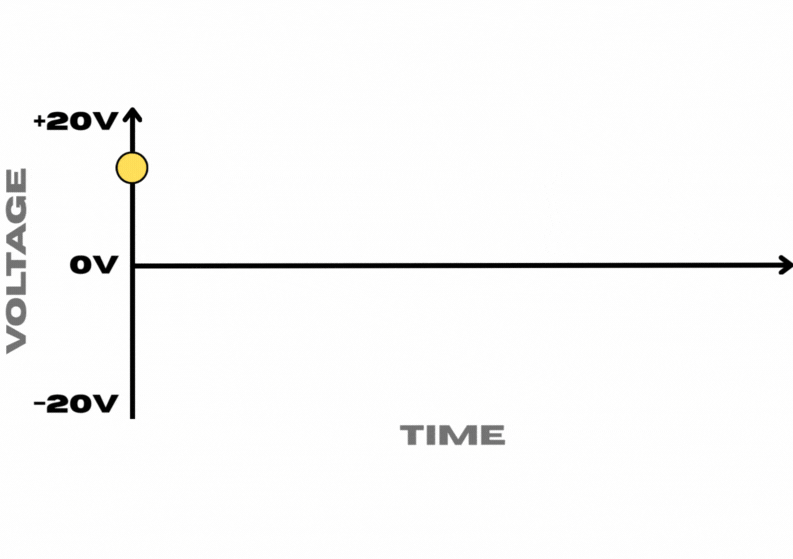
The Armature
A rotating shaft within a Dynamo holds a series of wound coils known as the Armature. This Armature rotates around the presence of a surrounding magnetic field. As the windings cross this magnetic field, a voltage is induced. The angle at which the windings cut through this field will influence how strong the induced voltage across the coil is at this point.

Split Rings
Unlike the Alternator output, the voltage of the Dynamo coils does not cross below 0V. This is because the current from the Dynamo's Armature is delivered to the terminals through what is known as a Split Ring or Commutator, connecting to electrical pads known as Brushes. As the Commutator rotates, the Split Ring flips the polarity of the windings, so that current is only produced in one direction. This ensures that power is being constantly directed to our battery, and not alternating, cycling between the current being pushed in and then immediately sucked out.
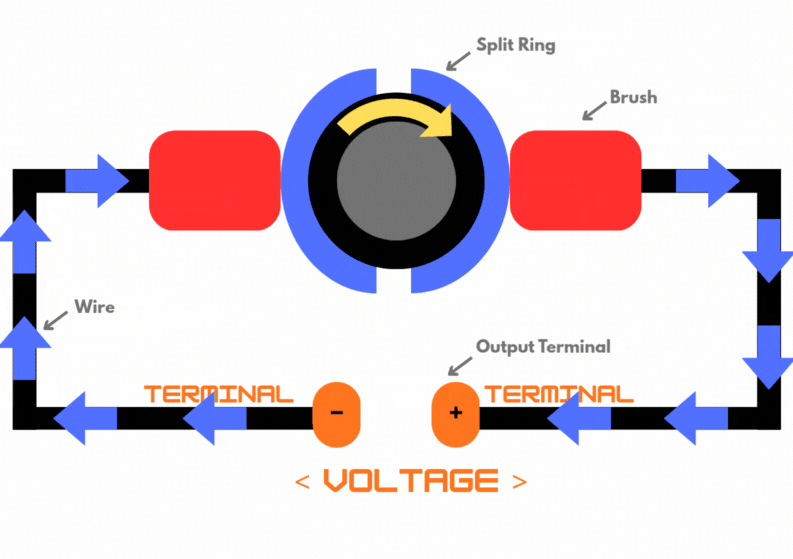
An Alternator, however, utilises separate Slip Rings for each side of the generator windings. These are complete rings that do not have a split to flip the polarity, with the AC output supplied to a rectification module located internally or externally to the Alternator casing.
Power Delivery
Compared to the more modern Alternator, the Dynamo does not deliver power as consistently, as evidenced by the dips in voltage mentioned earlier.
Where the Alternator triumphs in this area is due to the use of differently phased AC generator coils. An alternator is wired in either a Star or a Delta configuration as a 3-phase AC generator, rectified to a single DC output.
With the coils interlaced in phases, the frequency of a "peak" in one or more coils increases, with the distance between these peaks becoming much shorter, essentially overlapping. The simplified animation below shows that a "dip" in voltage from one coil is quickly counteracted by the "peak" of another coil of opposite polarity.

Once rectified, the resultant outputs will have fluctuation with minimal differences in amplitude compared to the Dynamo. This should create a supply with small ripples rather than the large waves seen before.

With more consistent power delivery, lights will appear less flickery at slow tickover and produce a more powerful, cleaner output. This is required to support a larger number of current-demanding electrical systems and noise-sensitive electronics.
Regulation
The dynamo requires a control box that typically controls the Dynamo in three ways. This includes regulating the voltage, current and connection to the battery.

A voltage monitoring circuit controls the ground feed to the field coil. If the Dynamo produces a voltage that exceeds a set threshold, restricting the power flowing through the field wire will reduce the voltage induced in the armature to a safe level. This is implemented by the "vibrating" contacts in a voltage relay, which quickly switch on and off to cut off a direct ground supply to the field wire. A resistor is placed in parallel to these contacts to provide an alternative and more restricted ground path when the contacts are open. This switching between a direct and a resistive ground path to the field influences the strength of the outer magnetic field, thereby reducing or enhancing its effect on the generator's power output.
It is also important to control the generator's current flow. If the current draw through the Dynamo is too high, then it is crucial that this draw is restricted. This is to ensure that the Dynamo does not overheat and that the wires and other electrical components of the car's electrical system do not become overloaded.
The other regulator within the control box is known as the "Cut-Out" relay. When the dynamo produces a lower voltage than what is in the battery, such as when the engine has stopped, current could instead flow from the battery to the Dynamo. With the Dynamo now acting as a motor, this will drain the battery and risk overheating the Dynamo. This is especially so as the windings within are just coiled lengths of wire; without the dynamo moving, this creates a low-resistance path to ground, similar to a short circuit.
Advertisements provided by Google AdSense
This concludes the tutorial on flashing the Dynamo on a classic VW Beetle. Thank you for reading, and feel free to contact us through social media with any suggestions for future tutorials.
At Rewired Customs and Classics, we take pride in ensuring that our information is as accurate as we can achieve. Feel free to take a look at some of our reference materials used to fact-check our post.
Bibliography
[1]
A J Coker, Automobile Electrical Systems, 4th Edition. Newnes Technical Books, 1981.
[2]
Charles Surridge, Car Electrics Made Simple. Charles Letts Company Limited, 1971.
[3]
The Engineering Mindset, How Alternators Work - Automotive Electricity Generator, (Aug. 29, 2020). Accessed: Nov. 03, 2025. [Online Video]. Available: https://www.youtube.com/watch?v=jdSKlg80DjU
[4]
‘Dynamo testing on vehicle - YouTube’. Accessed: Oct. 29, 2025. [Online]. Available: https://www.youtube.com/watch?v=jtlrR-WgEyM&t=3s
[5]
Moss Motors, Ltd., Function of the Cut-Out Relay Explained, (Dec. 15, 2016). Accessed: Oct. 29, 2025. [Online Video]. Available: https://www.youtube.com/watch?v=VwMn-5NV5eM
[6]
The Vintage Garden Tractor Company, How to Polarize a Dynamo, (Apr. 25, 2018). Accessed: Oct. 29, 2025. [Online Video]. Available: https://www.youtube.com/watch?v=ZCV2sV08cNA
[7]
AirplaneInstructor, Vibrating Point Voltage Regulator for Generators, (Mar. 19, 2014). Accessed: Oct. 29, 2025. [Online Video]. Available: https://www.youtube.com/watch?v=Xy_FXudigqA
[8]
‘Voltage Regulator - How it Works Part 1 - YouTube’. Accessed: Oct. 29, 2025. [Online]. Available: https://www.youtube.com/watch?v=UxXuKOQTASE
[9]
Moss Motors, Ltd., Voltage Regulator - How it Works Part 2, (Jan. 29, 2009). Accessed: Oct. 29, 2025. [Online Video]. Available: https://www.youtube.com/watch?v=j5sfAebQPow


